
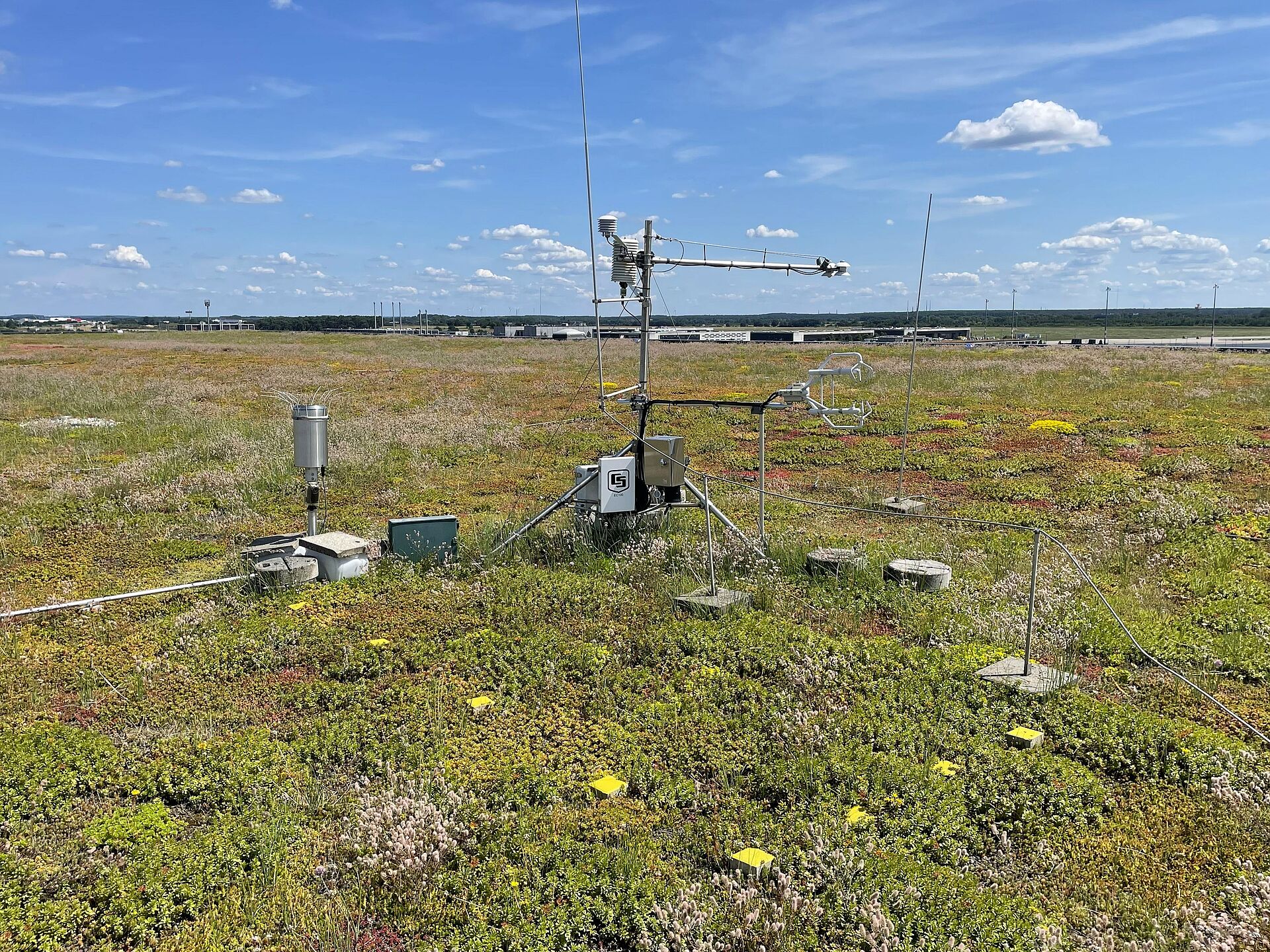
This study used nine years of eddy-covariance measurements (2015–2023) to evaluate interactions among carbon, water, and energy fluxes of a large extensive green roof in Berlin. Overall, the green roof functioned as a moderate carbon sink, and showed strong links between soil moisture, evapotranspiration, heat fluxes, and carbon uptake. In the final two years, the roof shifted from a carbon sink to a net carbon source, highlighting how changes in substrate carbon can influence the long-term performance of green roofs as carbon sinks.
Markolf, N. and Weber, S.: Net ecosystem exchange of extensive green roofs: the role of coupled energy, carbon, and water fluxes quantified by long-term micrometeorological observations, Biogeosciences, 23, 5035–5053, https://doi.org/10.5194/bg-23-5035-2026, 2026.