Technische Universität Braunschweig
  • Study & Teaching
    • Beginning your Studies
      • Prospective Students
      • Degree Programmes
      • Application
      • Why TU Braunschweig?
    • During your Studies
      • Fresher's Hub
      • Term Dates
      • Courses and Qualifications
      • Practical information
      • Beratungsnavi
      • Financing and Costs
      • Special Circumstances
      • Health & Wellbeing
      • Campus life
    • At the End of your Studies
      • Career Service
      • Alumni
      • Discontinuation and Pre-Certification
      • After graduation
    • Strategies and Quality Management
      • TU Teaching Award
    • For Teaching Staff
      • Strategy, Offers and Information
      • Learning Management System Stud.IP
    • Contact
      • Study Service Centre
      • Academic Advice Service
      • Student Office
      • Department 16 - Academic and Student Affairs
      • Career Service
  • Research
    • Research Profile
      • Core Research Areas
      • Clusters of Excellence at TU Braunschweig
      • Research Projects
      • Research Centres
      • Professors‘ Research Profiles
    • Early Career Researchers
      • Support in the early stages of an academic career
      • PhD-Students
      • Postdocs
      • Junior research group leaders
      • Junior Professorship and Tenure-Track
      • Habilitation
      • Service Offers for Scientists
    • Research Data & Transparency
      • Transparency in Research
      • Research Data
      • Open Access Strategy
    • Research Funding
      • Research Funding Network
      • Research funding
    • Contact
      • Research Services
      • Academy for Graduates
  • Transfer
    • Transfer profile
      • Transfer strategy "TIES® with Impact"
      • Technology Transfer
      • Knowledge Transfer
      • Relationship Management
    • Innovation
      • Startups
      • Patents
    • Offers for schools and pupils
    • For enterprises
      • Friends & Supporters
    • For Alumni*ae
    • For everyone
  • International
    • International Students
      • Why Braunschweig?
      • Degree seeking students
      • Exchange Studies
      • TU Braunschweig Summer School
      • Students from German Schools Abroad
      • Refugees
      • International Student Support
      • International Career Service
    • Going Abroad
      • Studying abroad
      • Internships abroad
      • Teaching and research abroad
      • Working abroad
    • International Researchers
      • Welcome Support for International Researchers
      • Service for Host Institutes
    • Language and intercultural competence training
      • Learning German
      • Learning Foreign Languages
      • Intercultural Communication
    • International Profile
      • Internationalisation
      • International Cooperations
      • Strategic partnerships
      • International networks
    • International House
      • About us
      • Contact & Office Hours
      • News and Events
      • Newsletter, Podcast & Videos
      • Job Advertisements
  • TU Braunschweig
    • Our Profile
      • Aims & Values
      • Regulations and Guidelines
      • The University Development Initiative 2030
      • Ecoversity – the TU Braunschweig as a university ecosystem
      • Facts & Figures
      • Our History
    • Presidency & Organisation
      • Executive Board
      • Designated Offices
      • Administration
      • Facilities
      • Committees
    • Career
      • Working at TU Braunschweig
      • Vacancies
      • Information and Offers for New Employees
    • Faculties
      • Carl-Friedrich-Gauß-Fakultät
      • Faculty of Life Sciences
      • Faculty of Architecture, Civil Engineering and Environmental Sciences
      • Faculty of Mechanical Engineering
      • Faculty of Electrical Engineering, Information Technology, Physics
      • Faculty of Humanities and Education
      • Institutes from A to Z
    • Events
  • Search
  • Quicklinks
    • People Search
    • Webmail
    • cloud.TU Braunschweig
    • Messenger
    • Cafeteria
    • TUconnect (student platform)
    • Courses
    • Emergency
    • Stud.IP
    • Library Catalogue
    • IT Services
    • Information Portal (employees)
    • Link Collection
    • DE
    • EN
    • Instagram
    • YouTube
    • LinkedIn
    • Mastodon
    • Bluesky
Menu
  • TU Braunschweig
  • Faculties
  • Faculty of Electrical Engineering, Information Technology, Physics
  • Institutes
  • elenia Institute for High Voltage Technology and Power Systems
  • Research
Logo Institut für Hochspannungstechnik und Energiesysteme der TU Braunschweig
IKTres

IKTres

Projektlogo

Preventive and curative measures for the compensation of communication disruptions and failures towards a resilient, active and digitalised distribution grid

Motivation

As a result of the energy transition, both the decentralised, fluctuating share of generation and the electrical demand in the low-voltage networks of the electricity supply system are increasing in equal measure, meaning that a reliable, multi-directional communication infrastructure – in particular via smart meter gateways within the intelligent metering system – is essential in order to control flexibility offerings and to maintain system equilibrium. Given the growing complexity and significance of these interfaces for operational management, their functionality and robustness must be continuously developed and tested for future grid and system operation.

Overall Objective

The IKTres project aims to address this challenge in the field of resilience of system operation management and to provide an answer as to how fault impacts caused by communication disruptions and failures in low-voltage distribution grids can be efficiently prevented, compensated for or mitigated. Specifically, the project pursues the objective of rendering the use of ICT in the energy system, and particularly in the distribution grid, more resilient for robust grid management. The focus here lies on localising and identifying possible fault sources and on estimating fault impacts.
Through the development of fault detection measures, intelligent operational management strategies, and compensation measures at individual installations or HEMS, the aim is to minimise these fault impacts. In addition to analysing grid operation, the impact on the connected customer is also analysed. This achieves an improvement in the resilience of the critical infrastructure of electrical energy supply systems as well as an increase in the robustness of grid operation.

Workplan
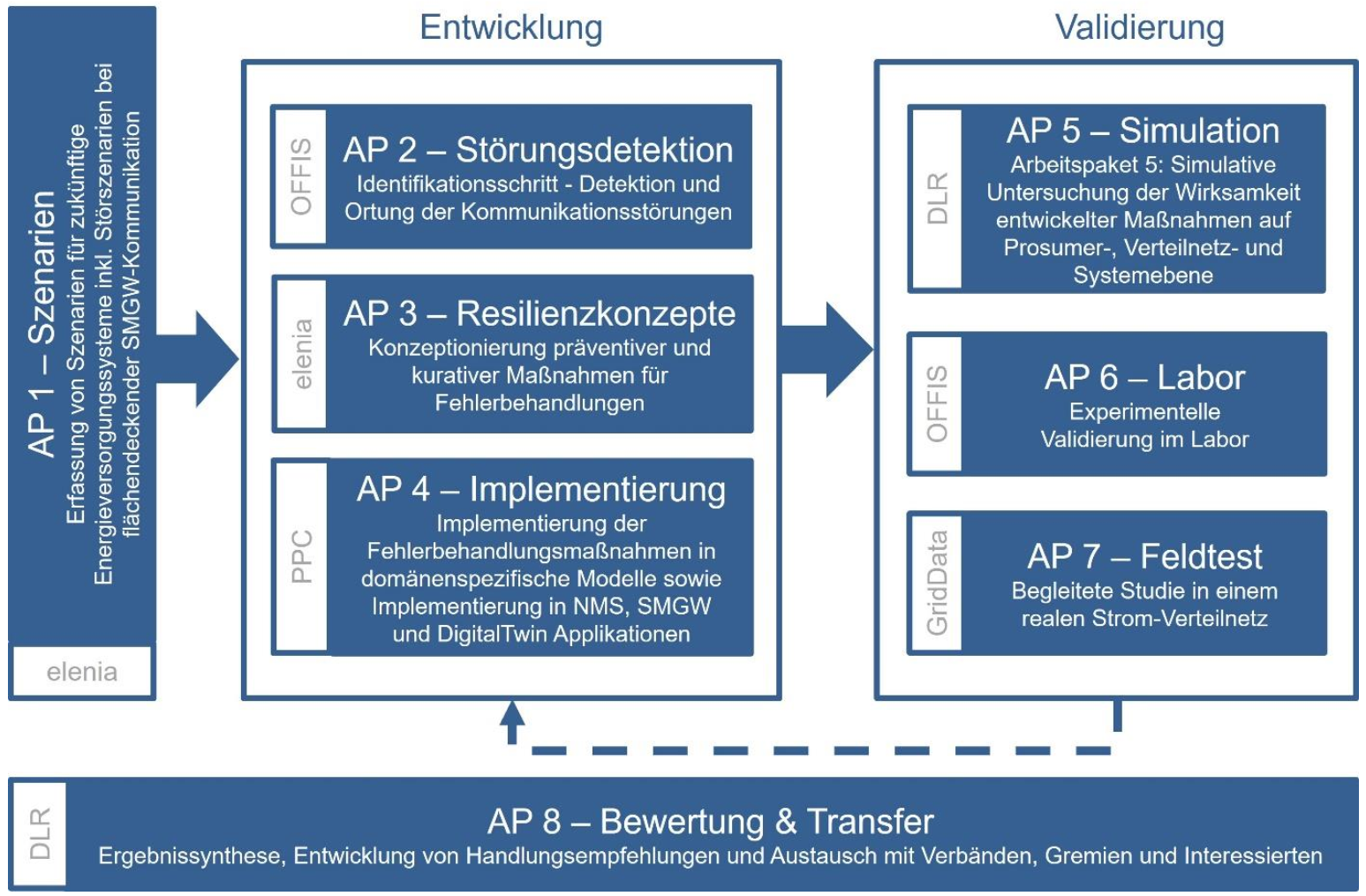
Projektstruktur

In order to address, assess and evaluate the challenges outlined above, possible future scenarios of ICT disruptions will be defined over the course of the project.
Building on this, a catalogue of fault detection measures and diagnostic procedures will be created, listing measures for the end-to-end communication between the DSO and controllable end devices as well as within the HEMS. This serves as the basis for further work in the field of communication reliability.
To reduce the susceptibility of ICT communication to disruption, the project develops and implements measures at the level of the network management system and of the communication module of the smart meter gateway in prototype form. The aim is to systematically capture and evaluate the operational and quality parameters of WAN communication and to make them usable for the early detection of communication disruptions. The approaches developed contribute to increasing the reliability of control measures, to managing communication failures more robustly, and to reducing their impact on downstream operational and control processes in the distribution grid. This makes a substantial contribution to increasing the resilience of the ICT infrastructure within the intelligent metering system.
A further objective is the analysis of the impact of the disruption scenarios on the operation of the distribution grids, should the fault remain undetected. This also includes possible interactions between different disruptions or cascading effects.
On the basis of the impacts of communication disruptions on the low-voltage networks of the critical electricity infrastructure, compensation measures are developed and evaluated. These may be preventive or curative in nature, whereby various categories are investigated and compared: measures at individual installations or grid components, operating strategies of home energy management systems (HEMS), protocols/processes within the SMGW, and grid control concepts.
The compensation measures developed, and their contribution to reducing the fault impact at installation, household, grid and system level, are investigated by simulation, in the laboratory and in a field test. The aim is a sensible trade-off between resilient grid operation and a minimally invasive restriction on the network user of the low-voltage grid.
The validation of the benefits of using a digital twin is carried out in a field test. Through the use of the digital twin, the aim is to represent the measurement data, to transmit control data via the SMGW, among other means, and to demonstrate their implementation through analysis of the measured values.
From the results of the simulations, the laboratory tests and the field test, assessments are derived evaluating the added value offered by communication via the SMGW in the distribution grid. This includes the assessment of both directions of communication: the possible added value for distribution grid monitoring through signals from the SMGW to the digital twin or the grid operator, as well as the added value for congestion avoidance through the sending of control commands from the grid operator to HEMS or individual installations. Furthermore, it is assessed how fault diagnosis can provide benefits for power grid fault detection.
Furthermore, for the ICT disruptions identified within the project, assessments of the impacts on the operation of the German and European interconnected system, respectively, will be made, for example whether critical situations can arise in low-voltage networks as a result of communication disruptions. At the same time, the effects of the compensation measures developed, and thus a possible solution to the challenge, are to be analysed.
The knowledge acquired through these investigations is intended to be fed into the discourse on the topic of ICT resilience. In this context, it is relevant that the significance of ICT at the low-voltage level will increase significantly over the coming decade, and indeed already within the next few years. The project aims to extend research in this field, so that large-scale disruptions can be minimised as effectively as possible through the resilience of this component (SMGW). This can, on the one hand, bring greater attention to this challenge, and, through the transfer of the knowledge acquired into expert committees and interested circles, the findings can contribute to increased energy system resilience.


Project Partners

Implementing Partners

Logo DLR
Logo elenia
Logo GridData
Logo Mainzer Netze
Logo Offis
Logo PPC

Associated Partner

Logo BSNetz
Logo Fenecon
Logo OpenEMS
Logo SMA
Logo Stadtwerke Weinheim
Logo Transnet BW
Photo credits on this page

For All Visitors

Vacancies of TU Braunschweig
Career Service' Job Exchange 
Merchandising

For Students

Term Dates
Courses
Degree Programmes
Information for Freshman
TUCard

Internal Tools

Glossary (GER-EN)
Change your Personal Data

Contact

Technische Universität Braunschweig
Universitätsplatz 2
38106 Braunschweig

P. O. Box: 38092 Braunschweig
GERMANY

Phone: +49 (0) 531 391-0

Getting here

© Technische Universität Braunschweig
Legal Notice Privacy Accessibility

TU Braunschweig uses the software Matomo for anonymised web analysis. The data serve to optimise the web offer.
You can find more information in our data protection declaration.