![[Translate to English:]](/fileadmin/Redaktionsgruppen/Einrichtungen/Projekthaus/Labs/WMM_Future_Skills/Banner.png "[Translate to English:]")
Navigating a digital world, fully harnessing the potential of media, and being prepared for the workforce of tomorrow through "future skills"—all of this is encompassed by the term Digital Literacy.
Students at TU Braunschweig have the opportunity to earn a certificate attesting to their proficiency in the fields of media, information, and digital transformation. This certificate program is open to students from all disciplines and is offered as part of the university’s interdisciplinary skills development curriculum (the "Pool" program).
Learn more about the Digital Literacy Certificate
In cooperation with the University Library and the Institute of Information Systems – Department of Information Management (wi²)
What is Digital Literacy?
Why does the Digital Literacy Certificate exist?
Who is the certificate intended for?
How is the certificate structured?
How can you obtain the certificate?
Any questions?
Not merely understanding digitalization, but being able to benefit from it; fully harnessing the potential of media; and being prepared for the workforce of tomorrow through "future skills"—this is what Digital Literacy encompasses.
Students at TU Braunschweig have the opportunity to obtain a certificate attesting to their proficiency in the fields of media, information, and digital transformation: the Digital Literacy Certificate.
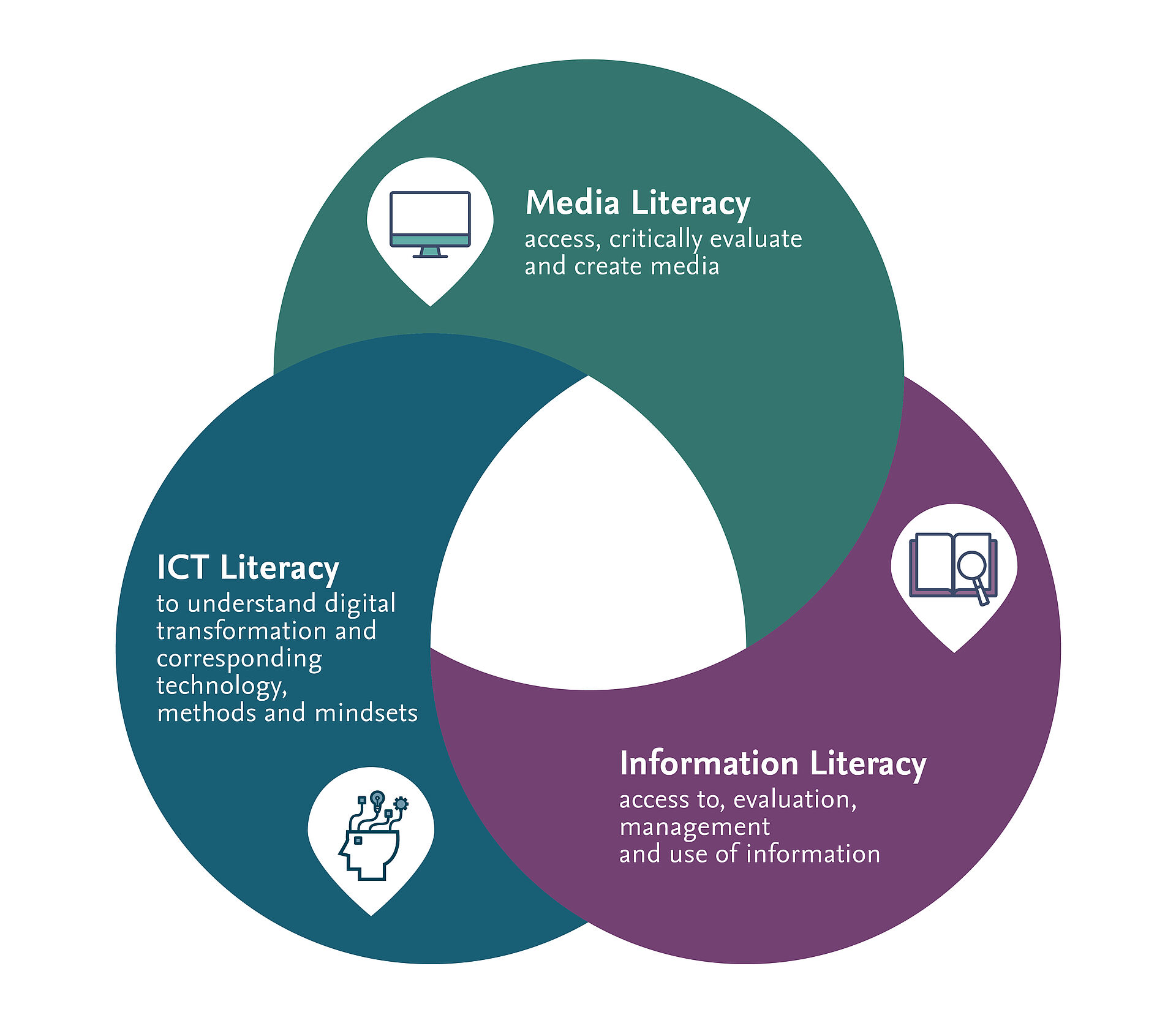
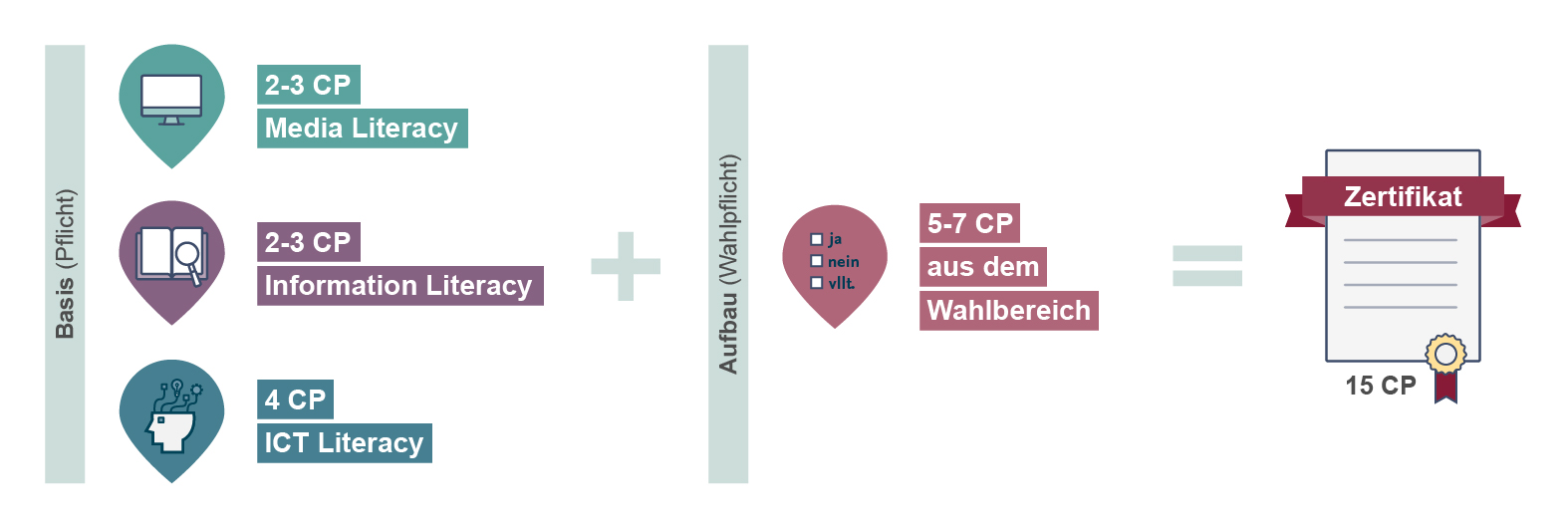
Digital literacy means being able to navigate one’s way through a digital world. While the term "literacy" technically translates to "basic reading and writing skills," in this context it signifies "knowledge," "understanding," or the "ability to handle something effectively." Digital literacy comprises the distinct areas of media literacy, information literacy, and ICT (Information and Communication Technologies) literacy (based on the *Framework for 21st Century Learning*).
Media literacy involves understanding (digital) media, critically questioning it, and being able to create one’s own media content.
Information literacy entails the ability to gather diverse information—as well as to manage, evaluate, and utilize it productively.
ICT literacy refers to the ability to understand and apply the digital transformation—along with the technologies, methods, and mindsets associated with it.
For the workforce of tomorrow—as well as for everyday life today and for engaging with academic coursework—competencies in the field of digital literacy are indispensable. For students, this means acquiring these skills. The Digital Literacy Certificate addresses this need by consolidating courses related to digital literacy while simultaneously providing students with the opportunity to document their acquisition of competencies in this area.
The certificate is aimed at students of all disciplines at TU Braunschweig and is offered within the framework of the university’s interdisciplinary qualification program (the "Pool"). Participation is free of charge.
In addition to attending the courses associated with the certificate, students remain free to have these completed courses recognized as part of their interdisciplinary qualification requirements (or other interdisciplinary modules).
To obtain the certificate, students must attend three mandatory foundational courses. In total, the certificate entails a workload of at least 8–10 CP and may be supplemented to any extent by credits earned from elective courses. Students may pursue the certificate at any point throughout the entire duration of their studies. They are entirely free to choose when to attend the associated courses.
Should you become aware of any other events that align thematically with this certificate program, please feel free to contact us.
If you have already completed courses belonging to this certificate program—specifically those within the "pool" category—during your previous studies, you may now have them recognized toward the certificate. Please do not hesitate to reach out to us regarding this!
To obtain the Digital Literacy Certificate, you must demonstrate that you have completed the relevant courses from both the core and elective modules, totaling at least 8–10 credit points (CP). Acceptable forms of proof include, for example, a certificate of attendance, a P-form, or an official Transcript of Records (grade report), provided that the specific course attended is clearly visible therein. Each individual course must be explicitly listed by title on the supporting documentation, and your participation must be clearly substantiated and verifiable.
If you are interested in working toward this certificate—or perhaps have already begun doing so—we kindly ask that you register via Stud.IP:
Mit Ihrer Anmeldung bleiben Sie auf dem Laufenden und werden über alle Neuigkeiten informiert.
By registering, you stay up to date and receive information regarding all the latest news.
Once you have completed all relevant courses, please send an email listing the courses to be credited—along with the corresponding proof of completion—to
digilit(at)tu-braunschweig.de.
Please do not send us any documentation until you have completed *all* your courses; submit all proofs together in a single email to ensure that nothing gets overlooked or lost. Individual submissions of documentation will not be accepted.
Once your documentation has been verified for completeness, your certificate will be issued in paper form. You will then receive an email from us notifying you that your certificate is ready. You may pick up your Digital Literacy Certificate at the Information Desk of the Braunschweig University Library.
This certificate is a joint offering of the Projekthaus, the University Library, and the Institute of Business Informatics – Department of Information Management (wi²), in cooperation with other TU institutions, as part of the Open Elective Area.
For questions regarding the structure of the program, credit recognition, or any other inquiries, the Digital Literacy Certificate Team is at your disposal.
Battelle for Kids (2019). Framework for 21st Century Learning. https://www.battelleforkids.org/networks/p21/frameworks-resources.
Bellanca, J. & Brandt, R. (2010) (Eds.). 21st Century Skills: Rethinking How Students Learn. Bloomington, IN: Solution Tree.
Trilling, B. & Faden, C. (2009). 21st Century Skills. Learning for Life in our Times. San Francisco, CA: Wiley.