

Technische Universität Braunschweig
  • Study & Teaching
    • Beginning your Studies
      • Prospective Students
      • Degree Programmes
      • Application
      • Why TU Braunschweig?
    • During your Studies
      • Fresher's Hub
      • Term Dates
      • Courses and Qualifications
      • Practical information
      • Beratungsnavi
      • Financing and Costs
      • Special Circumstances
      • Health & Wellbeing
      • Campus life
    • At the End of your Studies
      • Career Service
      • Alumni
      • Discontinuation and Pre-Certification
      • After graduation
    • Strategies and Quality Management
      • TU Teaching Award
    • For Teaching Staff
      • Strategy, Offers and Information
      • Learning Management System Stud.IP
    • Contact
      • Study Service Centre
      • Academic Advice Service
      • Student Office
      • Department 16 - Academic and Student Affairs
      • Career Service
  • Research
    • Research Profile
      • Core Research Areas
      • Clusters of Excellence at TU Braunschweig
      • Research Projects
      • Research Centres
      • Professors‘ Research Profiles
    • Early Career Researchers
      • Support in the early stages of an academic career
      • PhD-Students
      • Postdocs
      • Junior research group leaders
      • Junior Professorship and Tenure-Track
      • Habilitation
      • Service Offers for Scientists
    • Research Data & Transparency
      • Transparency in Research
      • Research Data
      • Open Access Strategy
    • Research Funding
      • Research Funding Network
      • Research funding
    • Contact
      • Research Services
      • Academy for Graduates
  • Transfer
    • Transfer profile
      • Transfer strategy "TIES® with Impact"
      • Technology Transfer
      • Knowledge Transfer
      • Relationship Management
    • Innovation
      • Startups
      • Patents
    • Offers for schools and pupils
    • For enterprises
      • Friends & Supporters
    • For Alumni*ae
    • For everyone
  • International
    • International Students
      • Why Braunschweig?
      • Degree seeking students
      • Exchange Studies
      • TU Braunschweig Summer School
      • Students from German Schools Abroad
      • Refugees
      • International Student Support
      • International Career Service
    • Going Abroad
      • Studying abroad
      • Internships abroad
      • Teaching and research abroad
      • Working abroad
    • International Researchers
      • Welcome Support for International Researchers
      • Service for Host Institutes
    • Language and intercultural competence training
      • Learning German
      • Learning Foreign Languages
      • Intercultural Communication
    • International Profile
      • Internationalisation
      • International Cooperations
      • Strategic partnerships
      • International networks
    • International House
      • About us
      • Contact & Office Hours
      • News and Events
      • Newsletter, Podcast & Videos
      • Job Advertisements
  • TU Braunschweig
    • Our Profile
      • Aims & Values
      • Regulations and Guidelines
      • The University Development Initiative 2030
      • Ecoversity – the TU Braunschweig as a university ecosystem
      • Equal Opportunity
      • Diversity
      • Sustainability
      • Facts & Figures
      • Our History
    • Presidency & Organisation
      • Executive Board
      • Designated Offices
      • Administration
      • Facilities
      • Committees
      • Student body
    • Career
      • Working at TU Braunschweig
      • Vacancies
      • Information and Offers for New Employees
    • Faculties
      • Carl-Friedrich-Gauß-Fakultät
      • Faculty of Life Sciences
      • Faculty of Architecture, Civil Engineering and Environmental Sciences
      • Faculty of Mechanical Engineering
      • Faculty of Electrical Engineering, Information Technology, Physics
      • Faculty of Humanities and Education
      • Institutes from A to Z
    • Events
  • Search
  • Quicklinks
    • People Search
    • Webmail
    • cloud.TU Braunschweig
    • Messenger
    • Cafeteria
    • TUconnect (student platform)
    • Emergency
    • Stud.IP
    • Library Catalogue
    • Research Information System
    • Information Portal (employees)
    • Link Collection
    • DE
    • EN
    • Instagram
    • YouTube
    • LinkedIn
    • Mastodon
    • Bluesky
Menu
  • TU Braunschweig
  • Faculties
  • Faculty of Mechanical Engineering
  • Institutes
  • Institute of Thermodynamics
  • Group "Molecular Thermodynamics"
  • Research Topics
Logo Institut für Thermodynamik der TU Braunschweig
Refrigerants
  • Research Topics
    • ← IfT Home Page
    • ← WG MolTh Home Page
    • Pharmaceutical Systems
    • Fuel cells and alternative fuels
    • Refrigerants

Refrigerants

Kältemittelsimulationen

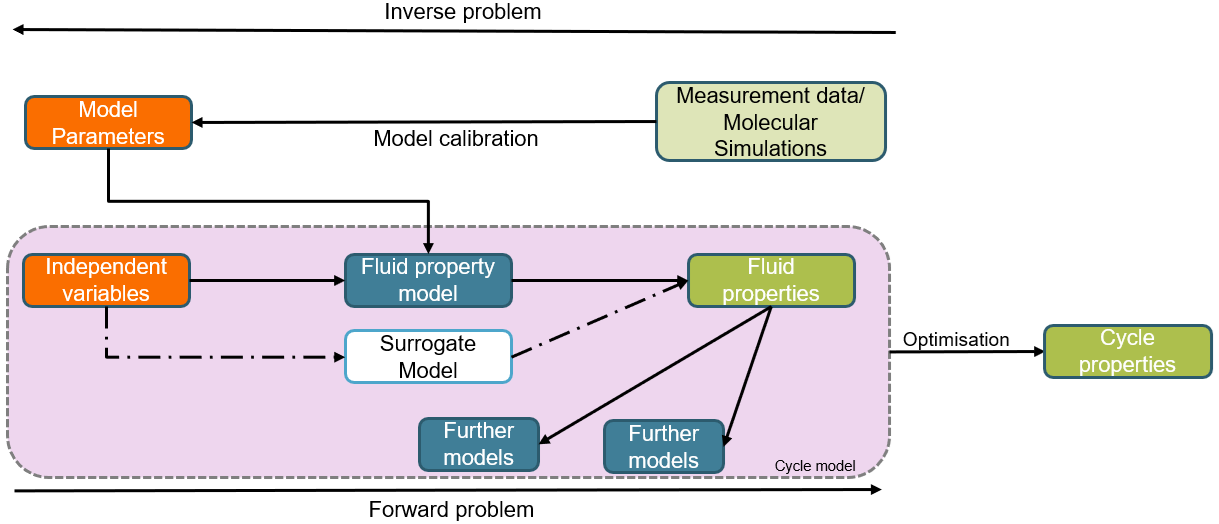
Prediction and SurrogateModelling of Thermodynamic Properties ofMixtures With Application to the Robust Design of Carnot Batteries in SPP 2403

[The selection and design of new, sustainable refrigerant mixtures require both high accuracy and fast, efficient calculations. Traditional Helmholtz‑Equation‑of‑State (HEOS) models provide reliable data, but they face two major limitations:

  • High computational cost in system simulations
  • Missing interaction parameters for many mixtures

The project will overcome these issues by:

  • Using molecular simulations to expand the HEOS database
  • Developing efficient surrogate models based on Gaussian processes (GP)

Main objectives

  1. GP‑based surrogate models for binary refrigerant mixtures in REFPROP
  2. Gibbs‑Ensemble Monte‑Carlo (GEMC) simulations to predict phase equilibria of mixtures
  3. Stochastic HEOS modeling: Bayesian calibration of interaction parameters in HEOS equations of state, explicitly accounting for model errors
  4. Formulating fluid selection as a mixed‑integer nonlinear programming (MINLP) optimization problem that directly incorporates the surrogates and their uncertainties

By combining machine‑learning surrogates, advanced molecular simulations, and robust optimization, we will create an efficient, reliable platform for developing climate‑friendly refrigerant mixtures.
 

Carnot project

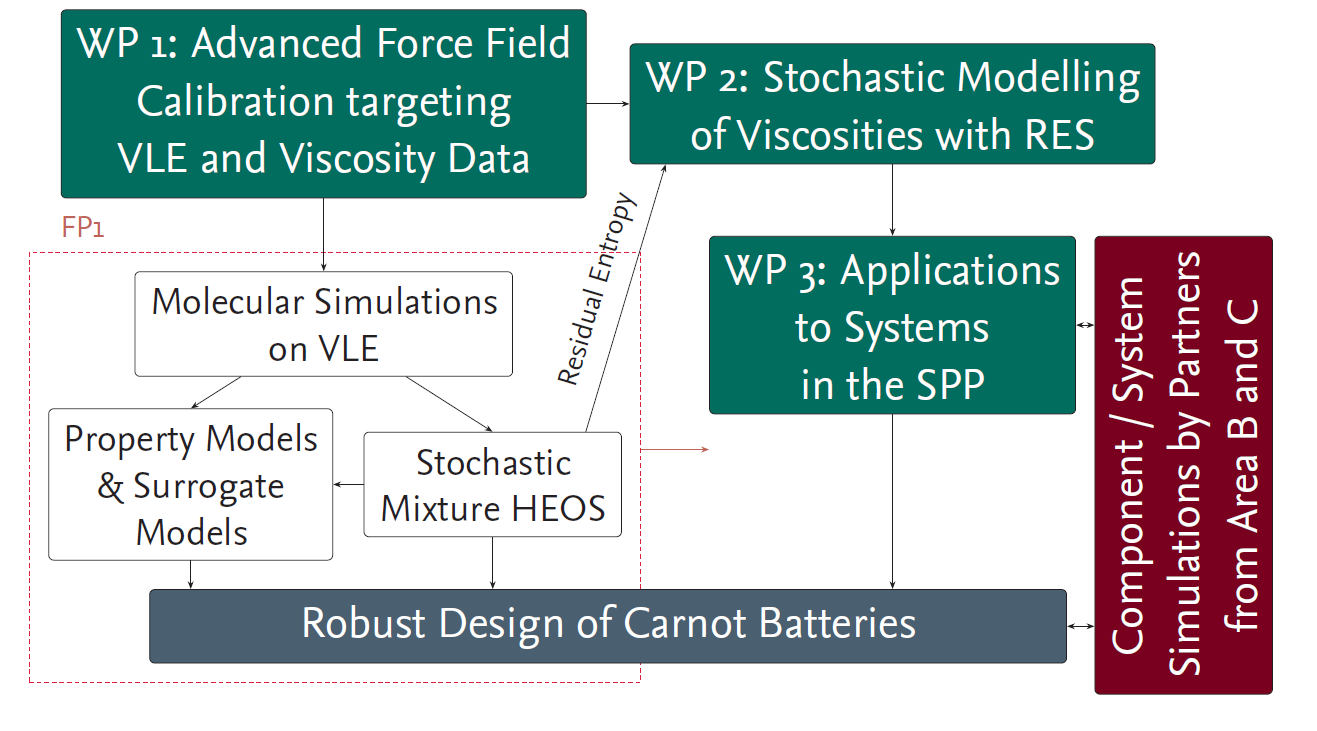
In the second funding phase of the SPP, mixtures of long‑chain alkanes are highlighted as promising working fluids. The goal remains to model relevant mixtures while systematically accounting for uncertainties—now not only for equilibrium properties but also for transport properties such as viscosities, which are described using Residual‑Entropy‑Scaling (RES). Uncertainties in the RES parameters and in the residual entropy are quantified with advanced, generalized Bayesian inference methods. Because experimental data are insufficient for development and validation, we supplement them with molecular simulations. The force‑field parametrization is performed simultaneously on the basis of both equilibrium and transport data. To use the viscosity values obtained from the simulations as a reliable reference, we are testing novel approaches for reducing their statistical uncertainty.
workpackages FP2

Thermophysical Properties of Alternative Refrigerants

Most heating, ventilation, air-conditioning and refrigeration (HVAC&R) applications today employ hydrofluorocarbons (HFC) as working fluids. Though these compounds are potent green house gases as they exhibit a high global warming potential (GWP).  Following the Kyoto Protocol to limit the emission of greenhouse gas, phase-out regulations for HFCs with high GWP became effective, which necessitates the adoption of alternative refrigerants. Refrigerant manufacturers have responded to this with the introduction of unsaturated fluorinated or chlorinated compounds as alternative working fluids, i.e hydrofluoroolefins (HFO) and hydrochlorofluoroolefins (HCFO).  

The exploration of the performance of new working fluids in potential technical applications requires a detailed knowledge of their thermophysical properties over a wide range of state points. As the commercialization of this new class of working fluids is in its early stage, experimental data on the thermophysical properties on newly introduced HFO or HCFO compounds are rare. This is especially true for mixtures, i.e. potential refrigerant blends.

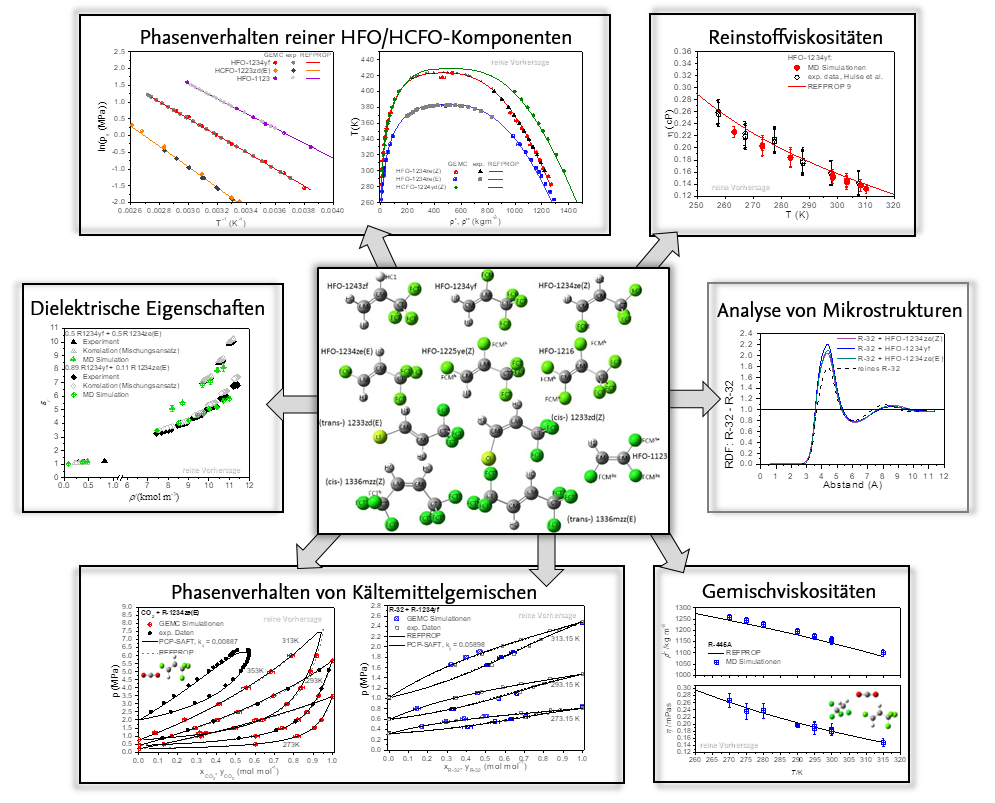
We have therefore developed a transferable force field for HFO and HCFO compounds to enable reliable predictions of the properties of these components and their mixtures by molecular simulations. We are thereby closely  cooperating with experimental and modelling research groups worldwide such as Ryo Akasaka (Kyushu Sangyo University, Japan) , Eric Lemmon (NIST, USA) or Eric May (University of Western Australia).

The simulation results are applied worldwide, for instance for the development of highly accurate empirical equations of state (EOS) for these compounds, or of mixing models to describe refrigerant blends.The simulation results are also used in the simulation program REFPROP from the NIST, which is widely used in the refrigeration industry. In our group, we are employing the simulation data to parameterize the PC(P)-SAFT EOS to also allow for the modelling of these new refrigerants and blends by a physically based molecular equation of state. 


Refrigerant-Lubricant Interactions

The aim of a newly funded project is a detailed understanding of the molecular mechanism of refrigerant-lubricants interactions, which is of fundament importance and high topicality for the development of efficient HVAC&R systems. For the first time, a systematic analysis of the fundamental interaction mechanisms between different current refrigerants and varying lubricants structures will be performed by molecular simulations.

Based on the simulation results a detailed analysis on the relation of molecular interactions and structures in mixture and the resulting properties such as solubility and viscosity will be performed to identify the relevant molecular interaction pattern in refrigerant-lubricant pairs. The results of the project will provide the scientific basis for the development of future refrigerant-lubricant pairs for sustainable HVAC&R systems.


Contact

Prof. Dr.-Ing. Gabriele Raabe

M.Sc. Leonard Schnelting

M.Sc. Eduardo Schneider


Photo credits on this page

For All Visitors

Vacancies of TU Braunschweig
Career Service' Job Exchange 
Merchandising

For Students

Term Dates
Courses
Degree Programmes
Information for Freshman
TUCard

Internal Tools

Glossary (GER-EN)
Change your Personal Data

Contact

Technische Universität Braunschweig
Universitätsplatz 2
38106 Braunschweig

P. O. Box: 38092 Braunschweig
GERMANY

Phone: +49 (0) 531 391-0

Getting here

© Technische Universität Braunschweig
Legal Notice Privacy Accessibility

TU Braunschweig uses the software Matomo for anonymised web analysis. The data serve to optimise the web offer.
You can find more information in our data protection declaration.