| Degree | Master of Science |
|---|---|
| Standard duration of study | 4 semesters |
| Language of instruction | German and English |
| Start of programme | winter and summer semester |
| Admission | free admission (special admission requirements) |
A sustainable power supply is an indispensable part of modern society, fundamental to our standard of living, our economy, and our security. The energy transition and shift from fossil fuels to renewable energies requires new technologies to meet this demand. This is precisely where the new Master's programme in Battery and Hydrogen Technology comes in.
Battery and hydrogen technologies are among the key technologies of the energy transition and offer enormous potential for a sustainable future. Specialists who understand these technologies and can develop and apply them in a targeted manner are in high demand, whether in electromobility, stationary energy storage or industrial processes.
Batteries are used in many different areas today, ranging from smartphones to electric cars and large-scale storage systems. Each application has specific performance, safety and service life requirements. This requires experts who can not only master battery systems, but also continuously develop them further.
Hydrogen is also opening up new possibilities: it can be used as an emission-free energy source in fuel cells or through direct combustion in high-temperature processes, and it can also be used as a climate-friendly raw material in the chemical industry. Hydrogen can therefore be incorporated into a wide range of everyday products, from mobility solutions to materials manufacturing.
On the Master's programme in Battery and Hydrogen Technology, you will learn how these technologies are produced, optimised, and utilised. You will develop a deep technical understanding and be empowered to play an active role in addressing global energy issues.
TU Braunschweig is located in one of Europe's most research-intensive regions and collaborates closely with various research institutions to enable world-class research. Centres such as the Battery LabFactory Braunschweig make us leaders in battery research. The H2 terminal at the research airport is creating unique infrastructure for hydrogen technology.
Close cooperation with other TU research centres, such as the Automotive Research Centre Niedersachsen (Niedersächsisches Forschungszentrum Fahrzeugtechnik, NFF), the Aeronautics Research Centre Niedersachsen (Niedersächsisches Forschungszentrum für Luftfahrt, NFL), and the Center of Pharmaceutical Engineering (Zentrum für Pharmaverfahrenstechnik, PVZ), supports practical teaching and creates opportunities for industry contacts during your studies.
The Master's programme in Battery and Hydrogen Technology is multilingual, with courses in both German and English. Students take three compulsory subjects in English and can also choose from German- and English-language elective modules, laboratories and interdisciplinary courses, allowing maximum linguistic flexibility. The dissertation and Master's thesis can be written in either German or English. Language courses in German and English are also offered to enhance language proficiency throughout the programme.
Apart from the three compulsory English courses, this means that the programme can be studied predominantly in German, entirely in English, or flexibly with a combination of German and English modules. This enables you to specialise in the language of your choice while deepening your knowledge in inspiring subject areas.
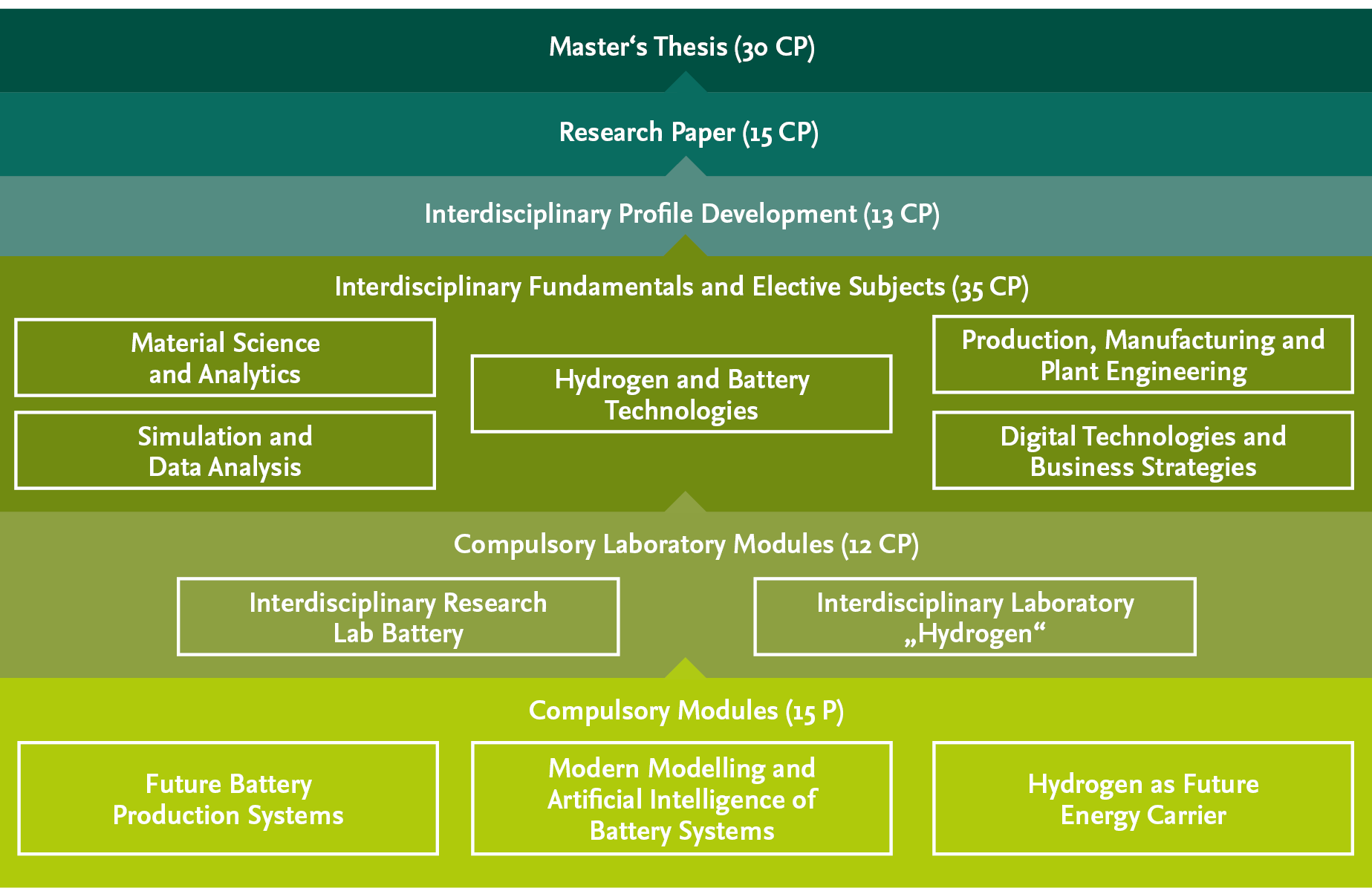
On the Master's programme, students take three compulsory modules in English. These modules build on the fundamentals of battery and hydrogen research, forming the basis for the rest of the programme. The majority of the programme, however, consists of optional courses that students can select according to their own interests. Thanks to the wide range of options available, each student can create their own personalised programme of study and thus develop their own specialisation, depending on their interests and linguistic strengths.
Admission to this Master's programme requires a completed Bachelor's degree in the same or a closely related subject. Please read the admission regulations (in german only) for details. You can apply for the Battery and Hydrogen Technology programme for the first time for the winter semester of 2026/27 via our online portal.
The structure of the curriculum ensures that, apart from the three compulsory English courses, the programme can be studied either predominantly in German, entirely in English, or flexibly with a combination of German and English-language modules.
For admission, applicants must
The following target levels should be achieved during the course of study:
In order to achieve these target levels, language courses in German and English are offered in the interdisciplinary module. If the target levels can already be demonstrated upon admission, the language courses are no longer compulsory.
More information on the admission requirements for international applicants