

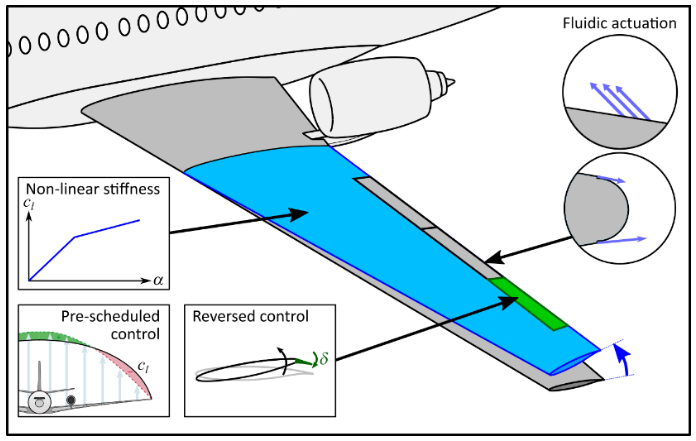
Effective load reduction enables a significant mass reduction of the primary structures of aircraft wings and - directly as well as through secondary effects - also a reduction of the overall mass of the aircraft. This leads to a decrease in energy consumption and emissions. Previous research has shown that both active and passive concepts reach their limits in reducing dynamic loads over the entire flight envelope and for the relevant load cases. This collaborative project aims to demonstrate the feasibility of hybrid load reduction concepts that combine intelligent structural design exploiting structural and geometric non-linearities with unconventional actuation methods such as fluidic actuators and control surfaces operated in 'reverse mode'.
First, reference use cases and requirements for combining the individual load reduction concepts and methods are defined. Then, the passive load reduction concept realised by non-linear structures is applied to the use cases. Parameter studies are to prepare the basic understanding for the combined concepts. Hybrid concept combinations will be developed with the project partners. The most promising ones will be selected and optimised for medium and long range aircraft configurations over the entire flight envelope. Based on these results, a comprehensive comparison of different hybrid concepts for load reduction will be conducted. The long-term goal is to first evaluate the load reduction potential and then the integration and compatibility with other systems, as well as the climate-relevant impact on the entire aircraft. This project will identify novel approaches to achieve significant load reduction, aiming at the realisation of a 1 g wing. It will also provide important insights for flight control, overall aircraft design and scaled flight demonstrators within the SE2A cluster.
Deutsche Forschungsgemeinschaft (DFG) (Cluster of Excellence)
2023 - 2025
Daniel Hahn, M. Sc. (since 2025), Jorge Bustamante, M. Sc. (2023-2025)

Institute of Aircraft Design and Lightweight Structures
Hermann-Blenk-Straße 35
38108 Braunschweig
E-Mail: ifl(at)tu-braunschweig.de
Telephone: +49 531 391 9903