
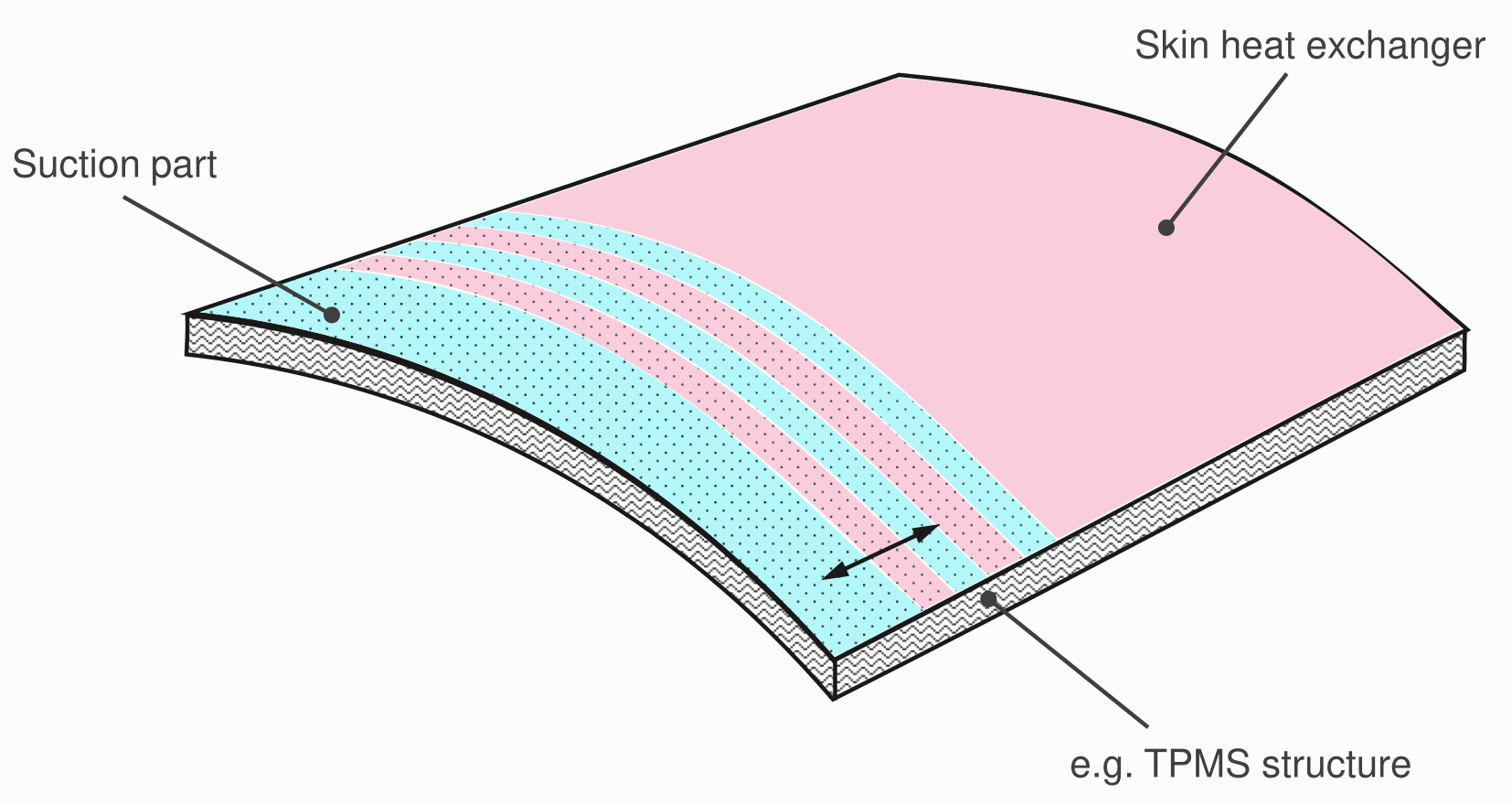
In the ATLAS research project, the IFL is developing innovative, multifunctional sandwich structures that can be used simultaneously as a load-bearing primary structure, a heat exchanger and for influencing the aerodynamic boundary layer – for example, through suction. Such functional integration is not yet state of the art, but is becoming increasingly relevant for future aircraft concepts featuring alternative propulsion systems and higher efficiency requirements. The aim of the project is to achieve maximum synergies by combining these functions in a single structural component, thereby reducing structural mass and the primary energy requirements of future aircraft.
The concept development is divided into three sequential phases. In the first phase, various sandwich concepts are systematically developed and evaluated on the basis of low-order methods and available literature with regard to their structural, thermal and fluid dynamic properties. Particular focus is placed on core structures based on TPMS geometries (e.g. gyroids) and a dual-chamber system that enables both extraction and cooling. From the range of variants, two concepts – an all-composite design and a composite-metal hybrid – are selected for in-depth investigation in Phase 2.
In the second phase, high-resolution, multidisciplinary modelling of the selected concepts is carried out using coupled FEM (Abaqus) and CFD simulations (OpenFOAM). Based on unit cells of the periodic structure, extensive parametric studies are conducted that systematically cover the design space and establish a robust database for data-driven surrogate models. At the same time, a sizing tool is being developed that enables the iterative adjustment of geometry and material parameters for individual panels.
In the third phase, AI-based surrogate models are provided as FEM macro-elements, allowing for an efficient representation of the multifunctional sandwich panels in global aircraft design models. These macro-elements compactly represent the thermal, structural and aerodynamic properties of the sandwich structure, thereby enabling integration into overall design studies at the system level. In the long term, the methods and technological building blocks developed are intended to be incorporated into further research projects, industrial collaborations and university teaching.
Bundesministerium für Wirtschaft und Energie im Luftfahrtforschungsprogramm (LuFo VII-1)
2025 - 2028

Institute of Aircraft Design and Lightweight Structures
Hermann-Blenk-Straße 35
38108 Braunschweig
E-Mail: ifl(at)tu-braunschweig.de
Telephone: +49 531 391 9903