
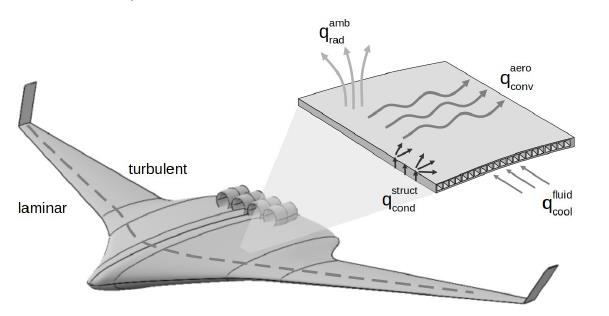
This project aims to explore the current technological blank spot of how the necessary dissipation of the waste heat of the fuel cell system via the aerodynamic surfaces can be achieved, especially in unconventional aircraft configurations such as the BWB configuration. The aim is not only to develop possible technological solutions but also to develop promising methodological approaches for modelling, analysis and optimisation.
This is done in close cooperation with the partner project "B4.1: Consistent Multilevel Model Coupling and Knowledge Representation in Multidisciplinary Analysis and Design", which deals with the general methodological approach for establishing a collaborative design environment, which is also to be developed and applied here.
For the concrete application, concepts for thermal management are being developed and the hitherto unknown sensitivities resulting from the coupling of the waste heat transport from the fuel cell via a cooling fluid and the heat conduction through the surface structure to the aerodynamic surface and from there to the aerodynamic flow around it are being analysed and investigated. The focus of the work here is on the thermal-mechanical structural design of possible surface panels, including integrity and adaptivity aspects.
In addition to the precise modelling of the individual disciplines involved and their consistent three-field coupling, an integral consideration of the entire system is carried out with the help of advanced multifidelity approaches and with the partners within the subprojects B4.1 and B4.2. This enables the optimisation with focus on the interactions of the surface with the external flow field, the weight-saving design of the internal structure with integrated cooling channels.
With the collaborative, multidisciplinary analysis capability involving the individual disciplines, the design spaces will be explored, characterised, researched and exploited.
Deutsche Forschungsgemeinschaft (DFG) (Cluster of Excellence)
2023 - 2025
N.N.

Institute of Aircraft Design and Lightweight Structures
Hermann-Blenk-Straße 35
38108 Braunschweig
E-Mail: ifl(at)tu-braunschweig.de
Telephone: +49 531 391 9903